Tuesday, January 21, 2020

Surprise! I left teaching.

I actually left several school years ago (end of the 2016-2017 school year), but I was looking through some of my files and wanted to share this letter I wrote to my last class of students as they graduated (class of 2018). I hope if you are still teaching, you take the time to write to your students. It doesn't have to be also long as this one, but just... talk to them. Talk to them about more than the subject you teach. Talk to them in a way that lets them know that you see them more than students - they're people - and that you are more than a teacher - you're a person, too.


Dear nuggets, (that's how I refer to y'all when I say nice things about you on Facebook; when I complain about you, I don't have a term, I just write I WANT TO POKE MYSELF IN THE EYE - all caps is necessary)

I wish it were possible for you all to know what an incredible experience it has been for me to be your teacher. It may seem strange for me to say that since I quit teaching, but teaching for 7 years, 3 of them with your class, is and will be one of the top three best things I will ever accomplish and has undoubtedly shaped me into who I am. There is really no better way to make an impact on the world than to work with the people who will build the future (I am imagine y'all as a little army that I have indoctrinated with science, recycling, sarcasm, and Harry Potterisms that will go forth and not be shitty* people) and there are few jobs that are as challenging. Even though teachers get paid pretty much nothing in most places throughout the U.S., and even though I don't advocate for drive-by teachers, even though I kind of was one, and even though it is so much work and I'm not really selling the job well right now, I really think you should consider teaching at some point in your life. There's a quote I put up in the girls' third floor bathroom one year that said, "some are lost in the fire, some are built from it." Well, teaching high school is like being on fire.

It can feel that way, because there are so many of you, all with different strengths and weaknesses, and there's this big sense of responsibility to help you become the best version of yourself, while also trying to teach you to read and do numbers and stuff. The great thing about it is that, even though it sounds cliche, it's true - you guys can become (almost) anything. You can become good things, bad things, or in-between things. This is both wonderful and terrifying to me. It's why I started teaching and why I stopped.

But back to you - you have your whole lives ahead of you to choose and build who you're going to be and a whole life behind you to support you in your choosing and building. I guess at most points in your life, you can find yourself at such a crossroad, but the end of high school really sets you up for a big one. I hope you feel like your parents, family, friends, teachers, peers, etc. have helped you gain and hone the tools necessary for going forward and I hope in time you'll gain and hone the ones you still need.

I'm only 12 years older than you (12 is my favorite number!) and probably also 12 inches shorter than you and a lot of you are more mature than I was at your age and I don't exactly know what I'm doing with my life as I am a rising senior in college... , but here are some things I have learned between the end of high school and now that might be useful to hear as you close one chapter and begin another, anyway:

1. Say what you mean and mean what you say. I'm not sure at what point in our lives we learn to respond to uncomfortable situations by word vomiting things we don't really mean ("Yes, long time no see - we should hang out sometime!"/"It's not you, it's me!"), but I've been spending the last half a decade trying to retrain myself to stop doing it. (Caveat: it does make people feel like I'm a lot less enthusiastic about things, because I'll say something is "good" rather than "really good;" well, most things -aren't- really good, but I'll let you know when I think they are!)

2. Figure out what you care about and speak up for those things. (I think I'm late on this one, because I feel like most of you guys are way better at this than I was at your age. Asians/women (?) are raised to avoid confrontation! (Unless you have a nuclear bomb facility, I guess.))

3. Don't take things/yourself too seriously. Few things that matter in the moment mean something the next year, or the next day, and most people are not scrutinizing you as much as you are scrutinizing you.

4. People need people. I like to spend time alone (it might have something to do with spending the last 7 years of my life with 150+ people/day and experiencing a mild third-life crisis) and there have been points in time where I became kind of a hermit, but everyone needs their people. It doesn't have to be a lot of people, and you should enjoy your me-time, but I don't think that people can go through life happily alone. It's just not in our biology - IB, AP, or otherwise. So find your people. As you go off to college, it's pretty much going to be the only time in your life when you're introduced to tons of new people who are also looking to meet new people. Take advantage of the opportunity to go out a bit of your comfort zone, but don't waste too much time on people you don't enjoy being around, doing things you don't really enjoy doing. And don't forget about the people you already have & like.

5. Relationships are harder after college. Those of you with international friends might already know this, but when everyone is out of school and on a different life schedule, you'll have to work harder to give relationships you care about the time they deserve. Take some time to think about which relationships you're willing to give that time (& energy) to.

6. Pay attention. Pay attention to how you feel after you've hung out with people, after you've gone somewhere, done something, or even after you've eaten something - if you feel good, keep doing it; if you don't, reconsider. Do the things that make you happy and feel good. As long as it's not hurting anyone and it's not bath salts or whatever new drugs are like bath salts.

7. Each year flies by faster than the previous. Don't rush, but don't dawdle either. You're going to probably spend the rest of your life trying to strike this balance. And every time you'll think you've gotten it down, life will prove you otherwise :) Don't worry. None of us know what we're doing & we're all just making it up as we go, whether we let people know it or not. But that's the fun, I guess, that we never get to peak & coast.

8. It's okay to live a normal life. You might feel like you should be doing "more" with your life, because it feels like other people are. You should be doing something with your life, but it doesn't have to be extravagant to be good.

9. It's okay to quit. I quit education grad school, because it killed my brain cells. Then I quit teaching, because I needed to not stay awake until 2 in the morning editing my PowerPoints (/wondering which of you I wasn't doing enough for/which of you were engaging in illegal activities). Don't keep investing time into stuff just because you've spent time investing time and know when it's time for a change/break.

10. It's okay to not be okay. It will probably be okay. Put in some effort, give things some time, you & the universe will work it out. But maybe if it feels not okay consistently for 2-3 weeks at a time, talk to someone about it.

11. Try to be nice to people. It's rough out here. People kind of expect kids to be jerks; your brains are still developing, your life is constantly in flux, and you might feel like you don't have as much control of as many things as you want, & that's fair, but adult jerks are 100% the worst and... you guys are kind of adults now, or you will be soon.

12. Speaking of, don't litter. Only terrible people litter.

Okay, so there's some sentiments from me for your next steps. I don't know if any of it is helpful, but you are my last students for a while and possibly forever, so I wanted to quickly gather some thoughts together.


Finally, this is probably the more important part of this email - I want to thank you guys for last few years. You might feel like B-CC shaped you, you might not feel like that. I didn't really go far out of my comfort zone when I was in high school or college; it's my time at B-CC that really shaped me. It's through teaching you guys that I became more patient, less of a control freak, and more open-minded. As much as I set out to teach you things, I learned a lot, too. While I am so ready for you guys to graduate so I can stop living a a double life as a nursing student and former teacher that seems to keep popping up at B-CC, I will always look fondly back on our time in the classroom: wapping you guys on the head for being on your phones, not grading potato labs three years in a row, listening to your kind of ridiculous hypothetical questions, wondering why so many teenagers can't spell nucleus, playing quidditch on days I didn't feel like doing anything, making you record DNA replication videos that you didn't want to do (but did anyway, thank you), lying on the floor when no one was listening to my lectures, worrying that someone might vomit at junior banquet (but no one did!), watching you attempt to design & execute experiments (one of which involved burning pineapples & many that involved breaking test tubes), and so on. While I've said that teaching is an incredibly difficult job, there's also few jobs where you get to laugh as much. I hope you guys enjoyed biology class as much as I did. It's really been a privilege to meet you as freshmen or juniors and to see you off now as soon-to-be college freshmen. You guys have accomplished a lot - both big & small, both individually & as a group - and have made a big impact on me. So thank you.

I'm proud to have been a part of your journeys & wish you the best with your next steps,

Ms. Le

Tuesday, November 15, 2016

I am Dying - A Rant

It's year 7. I'm supposed to know what I'm doing. spoiler alert: I don't.

I have been treading water every single school day for the last two years.

Last year, I took on a new prep and a new course - IB Biology. We previously taught it with AP Biology (wrong! - Donald Trump) and finally separated the two, so I started a new IB Biology course. It's a two-year class, but in the transition, we had to offer one section as a double-period course and another section as a single-period, two-year course. Then I also was teaching mixed-level Freshmen Biology (honors and on-level) with a new curriculum that was supposed to be project-based. Because the IB Biology course was only now getting separated from the AP course and we had never really done IB Biology correctly, I pretty much started from scratch and worked my way through it.

I should mention that I personally like starting from scratch. I'm a burn it all down, build it back up type of person. I love that my mark is on our IB Bio course. However, teaching the same course at two different speeds really messed up my mind. Also, while I was building this course, I had no time to learn the how the county wanted to run the Honors/On-level Biology course. I thought I could just go through day by day and read someone else's plan (they laid it out almost by script) and solely worry about IB Biology.

spoiler alert: I couldn't.

Actors can't act if they're only reading the script for the first time, so I'm not sure why I thought I could teach that way.

Oh, I also forgot to mention I started graduate school to pursue a master's in education last year.

So put all of that together, and you get someone who barely held it together. I asked to go part-time mid-year, at the semester break. Then I shed Freshmen Biology and was able to focus on IB Biology and grad school. Things felt doable. But then two months later, my school needed me to be a long-term sub for another teacher and I not only went back to teaching two IB Biologies and Freshmen Biology, I also added on Anatomy and Physiology, which I had never taught before.

Let me tell you, it was an absolute shit show and nobody learned anything, but everyone survived.

This year, I was slated to teach IB Biology 1 and IB Biology 2 (taught the correct way, with some incorrectness of the previous year carrying over). I was also slated to teach Freshmen Biology or Anatomy, but then our AP Biology teacher decided to stop teaching that course and I was asked to pick that up. And so I returned to this never-ending cycle of new courses. People act like it's great to have teachers cycle in and out of teaching classes so we don't get lazy or complacent or bored. I haven't been bored. Teaching something three years in a row isn't boring. It's an opportunity to hone and get better. I think it takes about 3-5 years to get really good at teaching a certain course. I haven't been afforded that luxury.

So this year, I am dying. There isn't enough time or energy in the world to properly plan for three classes and they're all lab sciences which add to the preparation load a more. I'm not doing a good job. I'm barely surviving day to day. Literally 4 out of 5 days of the week, for the last three months, has been a sprint. I want to do better than survive, but at the end of the day, there's not much time or energy for reflection and change of approach. I feel exhausted just describing the situation!

Sunday, August 28, 2016

Year 7

First day of school tomorrow. In Year 7, Harry didn't go back to school. He went to war! #samedifference #deathlyhallows

Wednesday, March 30, 2016

shit my kids write: honest, but not a scientist

student lab report: "due to an error on my part, my experiment was terrible."

Sunday, October 4, 2015

Everyone's an Advanced Student, Not Athlete

schools to kids who don't know science: of course you can take AP bio! you can do anything you put your mind to! schools to kids who can't catch a ball: sorry, you are not good enough for the team. catch up and try out next year.

Monday, June 8, 2015

How I Show I Care and How My Students Show Appreciation

"It's none of my business." - most people
"There are two kinds of evil people in this world. Those who do evil stuff and those who see evil stuff being done and don't try to stop it." - Mean Girls

So I thought that the latter quote was from Albert Einstein, but I just googled it to find that what he said is a little bit more serious than what I was going for (though I don't disagree and Einstein - you are awesome, clearly). I'm not ashamed to be quoting Mean Girls, it is a classic film of my and today's youth.

This year I've thought a lot about these two quotes. My parents, and I think America, have steadfastly and successfully lived their lives staying out of situations and explaining that it wasn't any of their business to get involved. I haven't really questioned it; staying out of certain situations seemed like a good way to not come off as being rude or intrusive. I have a need for people to like me, so of course I followed this life philosophy as to not become unlikeable. However, this year I began to wonder if "it's none of my business" really meant "it's not important enough to me to get involved."

We had a new teacher at my school this year and she began teaching AP and Honors Biology with our team. (Full disclosure: I wanted to teach AP Biology and I do teach Honors Biology. Her AP students were my Honors students two years prior and I felt a responsibility for their learning of biology.) Within the first quarter, it became clear that she did not intend on teaching the AP Biology curriculum, and to a lesser extent, the Honors curriculum. In terms of AP, she actually completely stopped teaching for almost the entire second semester by way of daily computer webquests.

I'm embarrassed to say that it took me until April to speak up. I just felt and still feel that this is one of the reasons our schools suffer - there are people teaching who have little desire to teach. I know that the students in my school are bright and little lasting damage will be done by having an absent teacher. But it just didn't feel right. It felt like my silence was saying "I see what you're doing - which is nothing - and I'm okay with it (or worse, I support it)." I spoke to my superiors about my concerns. Two weeks passed and there was no change. Students inched closer to their AP exams. Then I felt that it was time to speak to my coworker. No change.

So my students and I decided to schedule some after-school study sessions. We met maybe four times and honestly, they weren't always productive, but I wanted to do what I could to help. I don't know if I handled the situation in the best way. But I think it was important to do something, even if it came off as nosy or superior to my coworker. I think I would feel a lot worse about myself, had I stayed silent.


My students left me a thank you card in my mailbox. They said it was nice to know that someone in the school cared about their learning. Today was the last day of school. They brought me a thank you lunch of sushi and cake.

I'm not saying to teach for the cake. I'm saying to do what you can, where you can and that your students are your students even if they're not on your roster. I think it's important to speak up when you see something is wrong. I don't think it was none of my business. I think our students are literally every teacher's business.

Wednesday, January 21, 2015

The Truth About Schools

I became a teacher, because I believed that education was the great equalizer for all individuals from all sorts of walks to life. I believed that you might have a bad life, because you might have had a bad education.


False.


If students are lucky, they will have one or two teachers a year that they will really connect with.

If teachers are lucky, they will have a handful of kids a year that they will really connect with.

(Class size is one factor.)

If you do the math, in high school at least, I see my students for less than an hour a day. (Going back to class size, this means that after a beginning of class introduction and end of class closing, I could talk to each student for about one minute a day - but wait - I have to teach stuff too, so that's not actually how a teacher's life goes.) How could I have naively believed that education could defeat every other sucky thing going on in a kid's life? Yes, students spend 7 hours a day in school and yes, that's a lot of time. But where are students for the other 17 hours of the day? Yes, many students spend an additional 2 or 3 hours in extracurriculars, but still, where are they for the other 14 hours of the day? It's arithmetic. We simply cannot expect to win over the majority of kids who have unpleasant things going on the other ~2/3 of the day.

Yes, we can be the difference for some students. But we cannot for the others. It is just impossible. And it sucks, but that doesn't change the situation.

The biggest difference maker, I think, now having taught for 4.5 years, is having parents that want to have you and raise you the best they can. So don't have kids if you don't want an 18 year  lifetime commitment, don't have kids because of societal pressure, and don't have kids if you're not convinced you can make them your biggest priority.

Because then we all pay the price.

Tuesday, January 13, 2015

Just a Thought

I teach the way I was taught and the way I learn. I think it's hard not to, because I don't have a full grasp of what it's like to be a certain type of learner that is not my type of learner (and how could I?). At the same time, I try to make myself available for one-on-one help for students who don't easily learn the way I teach. I think that's all we can do. I'm sure there are teachers who are better than me at teaching to multiple learning profiles. However, I also think it's impossible - IMPOSSIBLE - for us to be expected to be five people at once or create five different activities for a concept, etc. We're asked to be flexible, and sometimes I am, so students should learn to be, too. Otherwise they're gonna run into obstacles they're not ready for outside of our padded walls.

Tuesday, January 6, 2015

Shit You Hear in Schools #1

Some of our failing students have 0's for some of their assignments. It has been suggested that some of our failing students have 0's for some of their assignments, because we teachers might have forgotten to update their grades after they submitted late work.

#teacheraccountability

Thursday, December 4, 2014

On Teacher Efficiency

I am literally the. world's. slowest. teacher.

It's a combination of things - I'm lazy and I procrastinate. But, also, I'm a perfectionist. Is that weird? Being lazy and a perfectionist? Maybe I'm lazy and I procrastinate, because I know it will take so long to get it perfect.

Writing a lesson plan or grading a test can literally take me days of work. This is not normal behavior. I marvel at the teachers who seem to have everything down and fly through their work. (Even though - snarky comment ahead - I know their work is not as beautiful as mine ;) Humbling comment follow up: but does it really need to be beautiful when students will look at it for less than 24 hours in total time?)

Anyway, I've been teaching for five years and I become more crazy about perfection each year to a fault. I don't think this will change. I'm neurotic and I know. There is conflicting information on whether neurotic people will live longer or shorter lives. However, I'm neurotic and not dumb and know something has to change if not my neuroticism. Here's what that change looks like for better efficiency:

1. Multiple choice quizzes and tests. If the MCATs can judge applicants on their medical knowledge and their aptitude for medical school through multiple choice, so can I. Grading time will not make me cry. If you search "writing better multiple choice questions," BYU and Vanderbilt have some useful tips if you're concerned about the quality of your multiple choice questions.

2. Rubrics. They take time to write, but make grading so much easier!

3. Try to grade something quickly after you receive them back - it's harder and harder to get back to it after a long time has passed.

Tuesday, September 16, 2014

the value of teachers

people don't look at their macbooks or iphones and say, "i wish steve jobs didn't work 12+ hour days." and i'm no steve jobs, but i'm tired of people telling me to stop working so long at school and, basically, to get a life. life is this journey around the sun that begs you to give those trips meaning. for some, that's having kids or finding a life companion, but for me, it's the legacy i hope to leave through my work. this priority may change if/when i decide to have kids and/ find a life companion, but i am perfectly happy with leaving my own, personal mark that i made with my own blood (i'm clumsy), sweat (the a/c at school doesn't always work), and tears (i have issues). i can't help but to wonder how much of people's well-intentioned, "get out of your classroom/it's terrible that you work so hard," has to do with the fact that i'm a woman and am "wasting away my youth" not finding a man or bearing children. but i'm a little busy, because i happen to have exactly 186 of them this year. or maybe it's because i'm not inventing the next iphone. but i promise you, if i do this right, what i'm making has the potential to be so. much. better.

Sunday, August 3, 2014

If I Ran the Zoo #1: Teacher Tenure

When I was in a elementary school, I collected Dr. Seuss books. One of them was called If I Ran the Zoo and I think it's an appropriate name for this series, where I hope to talk about current topics in education and my opinion on them as a generally competent, relatively new teacher.

Teacher Tenure

The facts:

1. There are incompetent teachers. There are teachers who hate teaching. I have worked with them. They are teaching someone's children.
2. The incompetent/lazy/bad attitude teachers I worked with were veteran teachers with tenure.
3. Most teachers WANT to become better at teaching.
         3a. Most of these teachers are actively WORKING to become better at teaching.

My opinion:

The teacher evaluation system is not good. I'm sure it's different from place to place, but here's what I've experienced: in PG, as a non-tenured teacher, I was observed once every quarter for about 40 minutes; in Montgomery County, as a non-tenured teacher, I am observed once every semester for about 40 minutes. In PG, the four evaluations did not always happen one per quarter (sometimes it was two or three rapid succession evaluations in the same quarter closer to the end of the evaluation window) or the four evaluations did not happen (maybe two or three). You're supposed to have a pre- and post-conference, but again, this does not always happen - in PG or Montgomery County.

If I ran the zoo:

1. Administrators would be in classrooms more than just enough to do the evaluations. Why? Because people who run the school should know what's going on in the school. I know some teachers are against this, because they feel that some admin are vindictive and are going to try to catch them doing something wrong. (And yes, some teachers are against this, because they ARE doing something wrong.) Heck, I don't love the idea of it either, because it makes me nervous to talk in front of adults. However, I feel that it's a necessary evil. We will get used to having people peeking in.

I would say that at least once a week, I'd like each administrator to drop in a classroom, even just for two minutes. When I worked in PG, I worked in portables/temporaries - NO ONE ever came to visit me unless it was for an evaluation. I literally could have not taught for all those other days. Now in Montgomery County, inside the school, administrators have come into my classroom maybe two times other than evaluations. This past year, the leadership team (admin + department chairs) started to pop into classrooms once a week, however any conversation that they had about my classroom was never shared with me (save a thank you email for allowing their presence).

These visits aren't meant to be evaluative, they're just so you as an administrator can talk about all the great stuff going on in your school and actually be believed that you know what's going on in the school. It's also so the lazy teachers might be pushed to get it together, if not only for the two minutes you're in there. But again, non-evaluative, because you wouldn't be in there the whole class. Just enough to see students ask a question or work on an activity or learn something quick about pre-calculus.

2. Teachers would be given a class off (NOT a planning period) once a quarter or so to go observe another teacher's class. I do this, but I've always used my planning periods. A teacher might say that going to see another teacher's class is a waste of time... not. No good teacher will say this. Because no teacher is perfect. But learning from someone else will get us a little bit closer. Plus, I've always left invigorated and inspired. I've learned something about their content and I've left with an increased amount of respect for that teacher and increased feeling of community.

So I'm not sure if I'd have a sub in all those classes for a period, that would probably be the easiest. But we could also do a study period for all those classes. For example, all science teachers would have off period 1, send their kids to the cafeteria, library, or computer lab, etc. and a sub, team of subs, or administrator would hold down the fort for that 45 minutes. Okay, so I'm not sure on the logistics, but I don't run a school yet ;) All I know is that there is value in learning from each other.

3. Teacher tenure would be awarded for teachers who have been teaching for 5+ years. I say this, because so many people have told me that they didn't feel they were competent teachers until the 4-5 year range. Non-tenured teachers should be evaluated 4 times a year - once each semester by an administrator and once each semester by a department chair. Tenured teachers, twice a year, by department chairs. New to school teachers? First year, you will be evaluated as often as a non-tenured teacher.

Also I kind of think pre-conferences are a waste of time. Only post-conference necessary, and that must occur within a week of the observation.

What if a teacher was not up to snuff? In the post-conference, next improving steps should be talked about and provided in a check list. Another evaluation should be had that year, either already planned or additional.

What if a teacher was still not where they should be? They should be assigned to a mentor teacher in the school who will help and evaluate them for the next school year. Upon this mentor teacher's recommendation, this teacher may or may not be kept. I'm not an expert on tenure (I am just getting it!) or evaluations, but I hope this all seems legitimately reasonable. In short, there should be checks and balances, a one-year remediation program, and protection for teachers who feel that they are being bullied by administrators who don't like them. We need to try to help teachers before firing them.

I agree that unions and tenure and paperwork have made it difficult to fire bad teachers. However, I also think that most teachers are not bad.

I agree that bad teachers seem to be concentrated in poorer school districts. However, being able to fire all these bad teachers does not mean that good teachers will magically flock to these schools. Teacher tenure is NOT why these schools have higher percentages of bad teachers.

4. I wouldn't be against parent/student surveys on teachers. Not open-ended. That could get disastrous. The majority of parents or students will be honest. They will cancel out the crazy.

Saturday, August 2, 2014

Test Bias

This is still one of my favorite videos about education. It's good for a laugh when you're feeling stressed out!

I HAVE Thoughts

Long time no see, internet void!

I was largely unable to blog this past year because teaching was kicking my butt so much that my head couldn't form coherent thoughts, much less will my fingers to type them out. In a short overview: I taught; Most kids were great, more kids than the previous year just couldn't muster enough of an attention span; The school environment had a weight on it, things felt more stressful and unfriendly this year; I survived and I still enjoy my job. Throughout the year, topics that I wanted to blog about kept coming up, but like I said, my brain was mush.

Now it's August and school is upon us! I guess the most useful thing I could blog about is advice for new teachers, so let's have a go:

1. It will never be perfect. I'm a perfectionist. My co-workers have joked that, after we plan an activity, they have to leave me alone for six hours so that I can format it. This is true. I will take every minute of that six hours. However, there will STILL be typos, things you wish you added, or ways you could have better worded something. Accept this. (I finally have!) Accept good enough. (And edit it with all those changes after for next year, but it STILL won't be perfect!)

2. Speaking of accepting good enough, know that so LITTLE of what you do has the ability to ruin a kid's life. Earlier in my teaching career, I told my kids some incorrect things (maybe a math rule or a science theory) and I was too insecure to say that I made a mistake. I didn't want them to think I was incompetent as I thought I was. But then I toiled over how this mistake would ruin their ability to understand the concept in the future. (What if they said something in their next class confidently, only to be told they were incorrect? - I have done this before when a student said, "But last year, Ms. So-and-so said...") Mini piece of advice 2a: Own up to your mistakes, as I've gotten older, I've gotten more comfortable with saying, "Sorry, guys, what I just told you was false." 2b: You will probably not ruin them or their ability to learn anything else on the topic, because of your misstep. One of the great things about teaching is that it FEELS SO IMPORTANT. And it is. We play a huge role in shaping our kids, BUT we have to try a little harder (or a little less, I guess) if we really want them to have a bad experience.

3. Do not stay up late to grade today's quizzes. Feedback, data, feedback, data. Sometimes it feels like people think we're computers. Students and admin are often all about instant feedback and data. Sometimes I just want to be like, YOU KNOW I HAVE TO READ THIS CHICKEN SCRATCH BEFORE I CAN GRADE IT AND WRITE COMMENTS ABOUT IT RIGHT?!

YES. Feedback and data are important. You and the students need to know where they're at. However, if you spread your grading over another day or two, you will: 1. keep your sanity, 2. provide better feedback, 3. be less likely to penalize students for small errors because you're not grumpy, 4. but also, be less likely to lower your standards because you're not sleepy, and 5. teach your students not only that you ARE NOT a computer, but also, that patience is a virtue. Making that decision to take the pressure off of myself has allowed me to be in my fifth year of teaching with nary a wrinkle or gray hair ;) (Just kidding, I just have great genes.)

4. Be you. New teachers, I did at least, want to 'fit in.' That can be that they want to be taken seriously or that they want to be the popular, funny teacher. One of the things I worried about most was being taken seriously. I started teaching when I was 21. I'm 5'2" (although my doctor recently said I'm 5'1 and a half! so maybe I didn't get wrinkles or gray hairs, but I'm compressing the pads that surround my joints). And I have the same face that I had when I was in 5th grade. I tried to act very seriously when I started, but in actuality I'm not a very serious person. I make jokes in my head all the time, I'm sarcastic, and honestly, very young at heart. It was exhausting trying to be that serious person I wasn't. Being able to make science or Harry Potter jokes in class has allowed me to enjoy my job so much more and the kids know that I'm being genuine. I'm certainly not the most popular or the funniest teacher, but I have added something valuable to my community.

If you are concerned with being taken seriously when necessary, (which I still am, because my personality causes me to yell out, "ARE YOU KIDDING ME?" and "WHAT DID I DO TO DESERVE THIS?" in the middle of class when I'm not looking to be taken particularly serious) be the teacher who kids know is xyz (e.g. fun and joking) when you're not in trouble, but firm, consistent, and fair when you are in trouble. I'm still working on this, but I do think it's working for me. Consistency is key, though, so remind yourself of this even when you're exhausted and just want to let the kid slide.

5. Eat lunch. Do all the stuff that makes you feel good and that is good for your health. It will make you a happier person and a better teacher. Also pack snacks. I snack during planning and after-school. :) No fuel in the belly, no fire in the brain!

6. You teach in a school, not in a classroom. You will likely get bogged down by a. how hard this job is, b. how tiring this job is, c. how needy this job is, etc. You are not alone. The thing that never fails to invigorate me as a teacher is reminding myself why I do it. You can remind yourself of this in a number of ways: 1. Talk to parents. Shoot an email with a compliment or concern. They likely will thank you and remind you that they value you; 2. Talk to your kids. Shoot an email with a compliment or concern. They likely will thank you and remind you that they value you; 3. Go to a school event. Anything - plays, sports games, concerts, etc. (Except high school dances. I fear those will not invigorate me, only embarrass me.) These events will also allow you to see your kids in a different light and value them for skills you didn't know they had.

I'm sure there's a lot more advice I could shell out, but these were the first things to come to mind. I hope you notice, soon to be new teacher or alien species who randomly came upon this blip in the interwebs, that my advice wasn't about how to plan or grade or even teach. All of that comes in due time, this stuff though will help you keep enough energy to hang in there long enough to master the other stuff.

Tuesday, October 8, 2013

It's an Uphill Battle

I'm learning, slowly, that (being a complete control freak) teaching is not routine. Teaching does not lend well to the perfectionist. And that teaching can be messy without being an actual mess. And as I type this out, my brain is imploding because its favorite thing is order.

Saturday, August 24, 2013

First Day, Year Four

Getting ready for the first day of school is always nerve-wracking, despite it being my fourth first day! I don't remember feeling overwhelmed on the first day when I was a student, but as a teacher, I feel overwhelmed just thinking about all of the handouts I provide my kids on day one.

One of the things I started doing last semester was writing a introductory letter to my students and having them write a letter back to me. I attached this assignment below! One of the new things I'm trying this semester is providing my students with a classmate contact sheet. I really want to push my students to be more proactive in their education. Too often I allow them to rely on me for things I feel are their responsibility. Students will have to find one other student in class to become their classmate contact. Next week, when I put them into lab groups, they will record three to four more classmates' contact information. The idea is that when they have questions, in or out of class, they turn to their peers before me. Additionally, I hope that this will build community and camaraderie in our classroom. This is also attached below.

The other new thing I'm trying is not having my students sit in an arranged seating chart from day one. I'm definitely a huge control freak, so this is out of my comfort zone. At the end of last year, I had this idea where I would have students choose their seats based on their needs. For example, if a student is really strong in science and doesn't get distracted easily, I would recommend them to sit in the back of the class. For students who are distracted easily or have a tendency to distract others, I would recommend them to sit in the front of the class. After I saw this on Pinterest, I printed my "recommendations" on post-it's and put them where I felt they were appropriate throughout my class. My students will pick their seats on day one, with my help if they're being honest about themselves, and write their names on the seating chart. We'll see how this goes. It may only last one week before I move them to where I like! Best of luck and skill and sanity for your first day back!


Update: This seating thing didn't work. The kids just sat with their friends, even if it was in a place that was not conducive to their learning. Lessons learned: 1. Don't be afraid to try new things. 2. If I want to do something like this again, I would have to survey students on seat preferences in a way that their friends' answers wouldn't be able to distract them.

Tuesday, August 13, 2013

Back at It

Hello, all! I start school in less than two weeks!

A couple of posts ago, I lamented about how few resources are available for teachers at the secondary (science) level. As a person who is constantly trolling (not sure if I used that term right, but the imagery of me as a troll is entertaining, so I'm going to leave it) Pinterest and the blogosphere for teaching inspiration, I've often come up empty. Even the very basics would have been helpful for me when I started teaching three short years ago. I had taken a couple education classes in my college years (and those "classes" that teaching fellows provided), but most of us Fellows showed up day one clueless. (Reminder to self to write a post on being new as a teacher/to a school and feeling so completely lost and scared, because there are expectations but you haven't a clue what they are or how to fulfill them and at the same time you are expected to know how everything works. Schools need a new teacher ambassador.)

I remember when preparing for class, the first thing I sat down to do was write my syllabus. So I sat down and stared at a blank screen. But I didn't know where to start, so it stayed blank for some time. Thank goodness for the internet (so weird how it didn't exist in my early school days); I started to google sample syllabi. Some were great templates, others were probably the first syllabus the teacher ever wrote and never went back to make it better. Because there are good syllabi and there are bad syllabi.

In my opinion, a good syllabus is short, but covers all the necessary day one bases. Some important things can be left off and covered in detail along the way. I also think of a syllabus as the "first impression" document for your class. It's probably the first hand out your kids will get and if you're required to post it online, like I am, it's the first document your parents will see. People may not comment, but they notice the little things - like spelling or layout. (Both of which I pride myself on.) I want to be taken seriously, so my syllabus should support that. At the same time, I don't (and can't) pretend that I don't have a weird sense of humor, so I inject that into the syllabus as well.

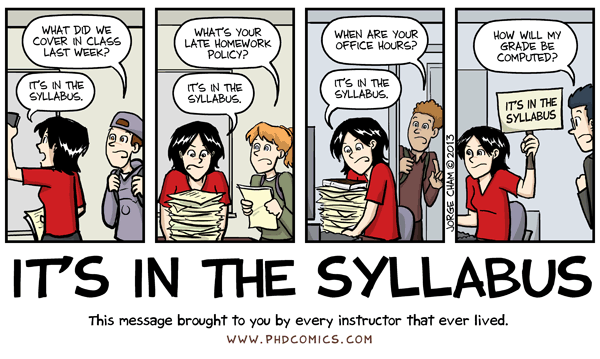
Below, I've scribd in my syllabus for this school year and also, a "syllabus fishing" assignment. The latter is so that my students actually read the syllabus and get to know it on their own time. In previous years, I've stood at the front of the class reading the thing. No mas. I put myself back into their shoes and remembered how the first day is just reading syllabi and filling out info cards. This year, I'm putting this responsibility on my students. The sooner they know my policies, the less headache I'll have later - "IT'S IN THE SYLLABUS!" :)

I've also linked some other great syllabi that I found while perusing the world wide web. Some of those linked are very graphical and unique! It makes me second guess my format, but I think I'll stick to the "traditional" layout for this year. I hope that this post is useful for those beginning to get back to work!

Friday, July 19, 2013

Actions Speak Louder than Words

I'm taking this teacher development class called Studying Skillful Teaching 1. We are using the text The Skillful Teacher: Building your Teaching Skills by Jon Saphier, et. al. One of the introductory portions of the text says teachers are important, because what we do is important.

Well, this is coming from a former teacher turned education researcher/advocate. So of course he believes that what teachers do is important. However, similar sentiments have come from all around, because who can be against teachers? Who can be against the people who spend several hours a day teaching children and trying to produce a better tomorrow ripple effect? This ripple effect is certainly why I became a teacher.

One of my fellow teachers turned to our table and said, "It's hard to believe that anyone really believes this. One example that comes to mind is class sizes." She is a middle school art teacher with more than thirty students in her class. Her statement caused be to start thinking about all the messages we get as teachers that tell us that what we do is not all that important and that we are not set up for success and that the powers that be do not really care about whether we succeed or not.

Class sizes is one thing. Thirty teenagers. One teacher. Honors biology. Forty-five minutes. If we subtract just five minutes at the beginning and end of class for announcements and reminders, it's really thirty-five minutes. Each student will get to interact with me, one on one, for less than two minutes a day. And I'm supposed to be teaching them how photosynthesis works. For the first time. Within two class periods. What am I, a magician? If they wanted us to be able to do this, they'd cap classes at 25. Back in the 90s I had an elementary class of 28 which I thought was huge. A 20-student cap would be better, but I don't want to ask for too too much.

What other job is a person expected to interact with that many individuals in that span of time? And not just hi and bye, but REALLY interact and make sure they were understanding something?

Income. Everyone always talks about this, so I won't.

The breadth of the curriculum. The curriculum is jam-packed from August to June. It is already tight even if you teach all 200 IQ students who are present everyday. But many students are absent once, or more, a school year. We have random school interruptions (e.g. fire drills, assemblies, lockdown drills, standardized testing, PSAT's, etc.). Asking us to cover so much information for every student, regardless of current capability or pace, is asking us to graduate these students to the next class without having them really have a solid foundation in the previous. And we wonder how students fall further and further behind each year.

Our say. Teachers are practically ignored when it comes to decisions that affect the classroom. We say that we don't like heterogenous classes (http://www.edutopia.org/node/6527/results), but we have to teach them anyway - and the idea of eliminating the on-level class (which means, eliminating the honors class) has been floating around. At my school, the on-level and honors class is mixed. It's like asking two different bands to play over each other at the same time. It's a headache. And should we not be regarded as the experts? Instead, the Department of Education relies on research done by people, most of the time, who are no longer teaching. When we would ever see the medical community changing the way they work based off of the sayings of an individual who hasn't practiced for years? So he says, this is the way we should start doing heart transplants, despite not having done one in a decade. And Mayo or Hopkins says to their surgeons, start doing this now though the man has very little current knowledge!

The idea that our job is so easy, we can reach perfection. No child left behind told us that it is possible to have EVERY student in the country meet proficiency in reading, math, and science by 2014. And if we could not meet this goal, we were failing the children. This has been said before, but I think it's so brilliant, I'll reiterate: this is like telling police departments across the country that all crime has to be eliminated by 2014. And let's not even say all crime. Let's pick three to represent reading, math, and science - homicides, robberies, and rape. And if police departments could not meet this goal, they were failing the country. Despite what you may think about the PD's of the U.S., no one, and I mean NO ONE, expects crimes to ever stop ... ever. Because humans are imperfect. We make mistakes, we have individual struggles. Some are just disinterested in living within the confines of the law. Whatever the reason is, we're never going to eliminate these three crimes and no one blames policemen.

Then come resources and the limited budget we're asked to work with. You put your eggs in the most important basket. When you shaft us on the resources we're allotted, you are telling us that we are not important.

Teachers and the education system are NOT important. Not until people start saying acting like they/we are.

Thursday, July 18, 2013

I Want My Honors Classes Back


I follow Edutopia on facebook. I think it's an awesome site and I peruse it sometimes when I'm in need of some very specific inspiration. What I mean by that is when I need that "Freedom Writers," We can achieve anything!, and We can significantly change lives within a couple of months! inspiration. After reading articles from successful schools on the site, I always feel like anything is possible in the classroom.

Today, they posted the above image with the lines, "Is "the homogenous honors class" a problem at your school? Read how one school took bold measures to tackle that problem: http://bit.ly/17oayv6." 

Full disclosure: I didn't click that link to read how one school took bold measures yet. I don't know if this post has anything to do with what I'm about to talk about. But it reminds me of the topic I'm about to talk about, so there's my inspiration for this.

And by homogenous, I believe Edutopia means Caucasian or Asian students. I'm for encouraging Latino and African-American students to pursue challenging courses that they may not, because they are unaware of the possibilities or because their peer groups are not taking these courses. If they are at the point in their education where they are able to handle honors classes, any student should pursue more challenge. But with this push, I'm not seeing a surge of capable Latino and African-American students pursue honors and AP classes. I'm just seeing a surge of students, of all races, that are not yet capable into these difficult classes. And until Latino and African-American students' test scores start to rise, I wouldn't expect a surge into these classes, either. There needs to be something else done instead of pushing birds out of a nest before they're able to fly. Honors classes won't solve the effects that poverty, which many minority students face, has had on their education and they aren't able to fill the gaps created after several years of struggling in a classroom.


When I was growing up, I took all honors or gifted/talented classes. (I find myself to be of average intelligence and even that is questionable some days...) When in elementary school, I was always in the "advanced" reading and math group and then when I moved to middle school, I was placed on the honors track, according to my test scores. Once you're in a track, you typically ride on that track until high school graduation. However, I did have a friend who really wanted to be in honors English, so she worked outside of class to bridge the gap (English was her second language) and then was promoted by our English teacher.

In school, I took classes with the same set of kids - honors kids - with the exception of the electives I signed up for every year. In my opinion then, all of these honors kids were high-flying, intelligent kids and I enjoyed taking classes where the class culture was to work very hard. Comments made in class generally felt additive to our education and I really enjoyed all of my classes from middle to high school.

The trend in schools today is to break down the track system. Students are allowed to take whatever classes they wish to, as long as they took (and in most situations, passed with a D) a pre-requisite course. We think that this is sending the message to kids that they are free to pursue anything they want. That's a great message.

But our execution of this message is poor and has produced some serious consequences.

At the highly-rated high school that I teach at, the school culture is to take honors and AP classes. Even if you're not ready or interested in doing the work required to keep up with them. That's all good and fine. You'll start to sink and then you'll make one of two choices: keep sinking or get swimming. And that is where we build self-character. But at what cost? Honors classes are beginning to fill with unmotivated, uninterested students who visibly have an effect on the rest of the class. As any chemist can tell you, reactions occur at the rate of the limiting reagent - you can only have the reaction move forward to the point where the least available reactant is used up. This leaves behind a lot of the other reactant, unused, unreacted. Classes have to move at a certain pace. If everyone is brilliant in that they pick up new information and solve problems quickly, the class will move quickly and keep these students engaged. If everyone is brilliant in that they pick up new information and solve problems slowly, the class will move slowly and keep these students engaged. When you mix combinations and variations of the two, you end up taking the average pace, or worse, taking the slowest pace because you don't want to leave behind any stragglers.

The fast kids get bored. These are generally the traditionally honors kids. They feel shafted. They aren't being as challenged as they would like to be. Some might say that differentiation is the key. But you are one teacher and when we push our kids - any of our kids - they value and require some support.

When I was completing my minor for secondary education, I was told (and I agree) that we learn best when we are out of our comfort zone - but not too far out of it. There's a "sweet spot" where new endeavors are difficult - but not too difficult. When the task is too easy, we get bored and disinterested. When the task is too hard, we get frustrated and disinterested. When the task is just right, we experience little wins and are able to keep working towards that goal. When we present our students with these attainable challenges, we need to be at the ready to support and scaffold.

Teachers are pretty magical folk, but to ask one person to support and scaffold three different groups (if that few!) in the same forty-five minute period is a bit crazy. I so value the times where I can really spend time with a group and have discussions and really push their thinking. I don't want to have my time and attention be divided. I want to send the message that I care and I want to help them get there.

Students are polite though. They know that there's only one of us. They know we don't have the time that we want to have with them. And that's a shame.

What I guess I'm trying to say is that this problem - teacher shortage - just gets multiplied by not just the number of students in a class, but the number of variations of needs. It's unfair to us as teachers and it's unfair for the kids. They deserve to learn at their pace and honestly, as a student and a teacher, I know that that best happens in a homogenous class.

I don't want you to think I don't value students of "different walks" or needs collaborating with one another. Electives help with this. But there does need to be time for students to work with like-minded students to push their limits. And all because there are two fast-working students in a class working together, that does not mean that they are the exact same. Despite their similar approaches to learning, each can still teach the other about different ways of thinking.

We currently have this country-wide school culture where we push all kids into one class, calling it "heterogenous" and "high expectations." We aren't leaving this pit stop any time soon. But if you think that this is truly the best way to help our children - all of our children - learn. I'm sorry to say, I'm pretty sure this is wrong.

What we're doing is like saying, "Anyone can be president!" (True statement.) And then literally letting anyone be president, regardless of how able they are at the present time. Maybe some are ready to lead at a young age. Maybe others aren't ready until much later. But making it law that people can run for the presidency at 35 is a great example of that flaw. We've had numerous candidates who meet that requirement and clearly have no capacity to lead the country. All because we have a bunch of high school freshmen, we can't make a blanket statement to say they're all ready to take honors biology. And if we really valued education, we would get real. YES, all students can achieve GREAT things. But a great thing may take one student a couple of days to achieve and others years. It is backwards thinking to put all of these students in the same class and expect good results. I wrote earlier on how the fast-paced students suffered from this arrangement, but so do the slower learners. If it takes me a year to master, say calculus integrals (this is probably true), but the curriculum guide allots one week to practice and master and then moves onto the next skill which also takes you a year of practice to master, when will I ever feel successful? I'm just going to keep "learning" new things, but never being good at a single thing, while I watch my peers speed on by.

In part, I have to admit, I'm writing this post, because I've seen my brightest students suffer, because I work the class to the middle. And I've seen my slower to catch on students suffer, because we have a lot to cover and I don't have to time to slow down and really work with them. But I'm also writing this as a teacher. Our schools aren't doing well. Shouldn't we try to make this job as easy and fool-proof as possible so we can better ensure success? Make my life easier. There's a ton of information for me to teach my kids for honors biology. With even fast-paced students, I can barely fit all I want to do with them into a school year. How can I realistically spend the time I need to with all different groups? When I taught special ed math I felt the same way. How can my kids be expected to learn the same exact things as their peers in the same amount of time with their inability to multiply, divide, or work with numbers that weren't whole? I truly believe that they would have been able to grasp the 7th or 8th grade math content ONE day, but not at that same pace. It is unreasonable. I don't see how others who aren't teaching can't see this.


Bring back the tracks. Make it easier for motivated, interested students to move up. Make it easier for the struggling students to move down and then up, with improvement. Heterogenous classes are saying that because one set of students is struggling, we should mix them with the high-flyers and hope something rubs off on them. Like grit is contagious. It's not. And if not, we'll have the struggling kids rub off on our high-flyers. And unfortunately, students acting out because of disinterest or difficulty CAN be contagious.

Thursday, June 27, 2013

Summertime Pinterest Development

Some teachers are able to revert back to their human lives when they return that classroom key and leave school for the summer. They enjoy the whole eight weeks of being student-free. They come back sun-tanned!

I am not one of those teachers. (Don't worry, I don't feel bad about it, so neither should you.) Many teachers enjoy their summer and teen/tween-free days, but still think about their classroom and curricula every now and then. Especially teachers like me, who are relatively new and just want to finally be better and a real teacher. We think of all the things we did not so well in the last school year and brainstorm how to improve. My pinterest page is filled with fellow teachers pinning ideas for the upcoming school year. We haven't been out of school for more than a couple weeks! This isn't a bad thing though. I'm very excited to return to work and continue to try to be awesome. One of the most disappointing things, though, that I've found is that pinterest and the internet in general is quite lacking in the high school teacher development area. There are tons of sites geared toward elementary school teachers; perhaps elementary school teachers like to share more or perhaps they have the time to share more. For a newish teacher like myself, I am constantly searching for great ideas and a different outlook, but often come up short.

This is probably what the first person who wanted to warm up leftovers felt like: but why isn't there a machine invented that can nuke this plate of Thanksgiving leftovers faster? And then there's me: but why aren't there more creative ideas and approaches to teaching high school biology? I mean, people have been teaching it for decades!! And this isn't just a lack of content on the web. Amazon and Barnes & Noble are quite lacking in the 9-12 department as well.

So I came to a conclusion. I'm going to have to pull a Percy Spencer (the man who invented the microwave, according to my two-second google search). I'm going to have to invent the ideas and approaches and be the one who makes something, hopefully useful, available for us biology teachers. While I highly enjoy typing endlessly my opinions on the downfalls of the American education system and the challenges I encounter regularly (this is not sarcasm, I love to vent), I think this approach may be a more productive use of my time. We'll see. I may end up like the many others before me, posting a couple times in September and October and then falling asleep with ungraded papers strewn about (this has happened to me at least twenty times this past school year) and never returning back to post.

:)