Saturday, August 24, 2013

First Day, Year Four

Getting ready for the first day of school is always nerve-wracking, despite it being my fourth first day! I don't remember feeling overwhelmed on the first day when I was a student, but as a teacher, I feel overwhelmed just thinking about all of the handouts I provide my kids on day one.

One of the things I started doing last semester was writing a introductory letter to my students and having them write a letter back to me. I attached this assignment below! One of the new things I'm trying this semester is providing my students with a classmate contact sheet. I really want to push my students to be more proactive in their education. Too often I allow them to rely on me for things I feel are their responsibility. Students will have to find one other student in class to become their classmate contact. Next week, when I put them into lab groups, they will record three to four more classmates' contact information. The idea is that when they have questions, in or out of class, they turn to their peers before me. Additionally, I hope that this will build community and camaraderie in our classroom. This is also attached below.

The other new thing I'm trying is not having my students sit in an arranged seating chart from day one. I'm definitely a huge control freak, so this is out of my comfort zone. At the end of last year, I had this idea where I would have students choose their seats based on their needs. For example, if a student is really strong in science and doesn't get distracted easily, I would recommend them to sit in the back of the class. For students who are distracted easily or have a tendency to distract others, I would recommend them to sit in the front of the class. After I saw this on Pinterest, I printed my "recommendations" on post-it's and put them where I felt they were appropriate throughout my class. My students will pick their seats on day one, with my help if they're being honest about themselves, and write their names on the seating chart. We'll see how this goes. It may only last one week before I move them to where I like! Best of luck and skill and sanity for your first day back!


Update: This seating thing didn't work. The kids just sat with their friends, even if it was in a place that was not conducive to their learning. Lessons learned: 1. Don't be afraid to try new things. 2. If I want to do something like this again, I would have to survey students on seat preferences in a way that their friends' answers wouldn't be able to distract them.

Tuesday, August 13, 2013

Back at It

Hello, all! I start school in less than two weeks!

A couple of posts ago, I lamented about how few resources are available for teachers at the secondary (science) level. As a person who is constantly trolling (not sure if I used that term right, but the imagery of me as a troll is entertaining, so I'm going to leave it) Pinterest and the blogosphere for teaching inspiration, I've often come up empty. Even the very basics would have been helpful for me when I started teaching three short years ago. I had taken a couple education classes in my college years (and those "classes" that teaching fellows provided), but most of us Fellows showed up day one clueless. (Reminder to self to write a post on being new as a teacher/to a school and feeling so completely lost and scared, because there are expectations but you haven't a clue what they are or how to fulfill them and at the same time you are expected to know how everything works. Schools need a new teacher ambassador.)

I remember when preparing for class, the first thing I sat down to do was write my syllabus. So I sat down and stared at a blank screen. But I didn't know where to start, so it stayed blank for some time. Thank goodness for the internet (so weird how it didn't exist in my early school days); I started to google sample syllabi. Some were great templates, others were probably the first syllabus the teacher ever wrote and never went back to make it better. Because there are good syllabi and there are bad syllabi.

In my opinion, a good syllabus is short, but covers all the necessary day one bases. Some important things can be left off and covered in detail along the way. I also think of a syllabus as the "first impression" document for your class. It's probably the first hand out your kids will get and if you're required to post it online, like I am, it's the first document your parents will see. People may not comment, but they notice the little things - like spelling or layout. (Both of which I pride myself on.) I want to be taken seriously, so my syllabus should support that. At the same time, I don't (and can't) pretend that I don't have a weird sense of humor, so I inject that into the syllabus as well.

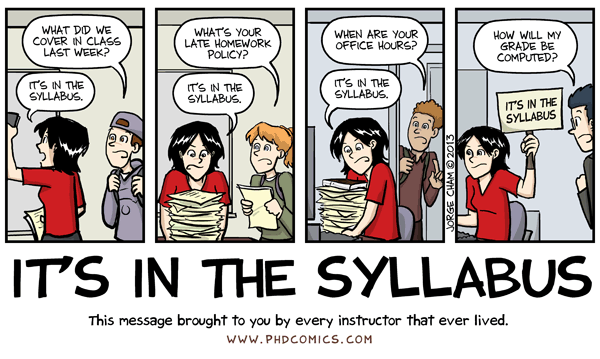
Below, I've scribd in my syllabus for this school year and also, a "syllabus fishing" assignment. The latter is so that my students actually read the syllabus and get to know it on their own time. In previous years, I've stood at the front of the class reading the thing. No mas. I put myself back into their shoes and remembered how the first day is just reading syllabi and filling out info cards. This year, I'm putting this responsibility on my students. The sooner they know my policies, the less headache I'll have later - "IT'S IN THE SYLLABUS!" :)

I've also linked some other great syllabi that I found while perusing the world wide web. Some of those linked are very graphical and unique! It makes me second guess my format, but I think I'll stick to the "traditional" layout for this year. I hope that this post is useful for those beginning to get back to work!

Friday, July 19, 2013

Actions Speak Louder than Words

I'm taking this teacher development class called Studying Skillful Teaching 1. We are using the text The Skillful Teacher: Building your Teaching Skills by Jon Saphier, et. al. One of the introductory portions of the text says teachers are important, because what we do is important.

Well, this is coming from a former teacher turned education researcher/advocate. So of course he believes that what teachers do is important. However, similar sentiments have come from all around, because who can be against teachers? Who can be against the people who spend several hours a day teaching children and trying to produce a better tomorrow ripple effect? This ripple effect is certainly why I became a teacher.

One of my fellow teachers turned to our table and said, "It's hard to believe that anyone really believes this. One example that comes to mind is class sizes." She is a middle school art teacher with more than thirty students in her class. Her statement caused be to start thinking about all the messages we get as teachers that tell us that what we do is not all that important and that we are not set up for success and that the powers that be do not really care about whether we succeed or not.

Class sizes is one thing. Thirty teenagers. One teacher. Honors biology. Forty-five minutes. If we subtract just five minutes at the beginning and end of class for announcements and reminders, it's really thirty-five minutes. Each student will get to interact with me, one on one, for less than two minutes a day. And I'm supposed to be teaching them how photosynthesis works. For the first time. Within two class periods. What am I, a magician? If they wanted us to be able to do this, they'd cap classes at 25. Back in the 90s I had an elementary class of 28 which I thought was huge. A 20-student cap would be better, but I don't want to ask for too too much.

What other job is a person expected to interact with that many individuals in that span of time? And not just hi and bye, but REALLY interact and make sure they were understanding something?

Income. Everyone always talks about this, so I won't.

The breadth of the curriculum. The curriculum is jam-packed from August to June. It is already tight even if you teach all 200 IQ students who are present everyday. But many students are absent once, or more, a school year. We have random school interruptions (e.g. fire drills, assemblies, lockdown drills, standardized testing, PSAT's, etc.). Asking us to cover so much information for every student, regardless of current capability or pace, is asking us to graduate these students to the next class without having them really have a solid foundation in the previous. And we wonder how students fall further and further behind each year.

Our say. Teachers are practically ignored when it comes to decisions that affect the classroom. We say that we don't like heterogenous classes (http://www.edutopia.org/node/6527/results), but we have to teach them anyway - and the idea of eliminating the on-level class (which means, eliminating the honors class) has been floating around. At my school, the on-level and honors class is mixed. It's like asking two different bands to play over each other at the same time. It's a headache. And should we not be regarded as the experts? Instead, the Department of Education relies on research done by people, most of the time, who are no longer teaching. When we would ever see the medical community changing the way they work based off of the sayings of an individual who hasn't practiced for years? So he says, this is the way we should start doing heart transplants, despite not having done one in a decade. And Mayo or Hopkins says to their surgeons, start doing this now though the man has very little current knowledge!

The idea that our job is so easy, we can reach perfection. No child left behind told us that it is possible to have EVERY student in the country meet proficiency in reading, math, and science by 2014. And if we could not meet this goal, we were failing the children. This has been said before, but I think it's so brilliant, I'll reiterate: this is like telling police departments across the country that all crime has to be eliminated by 2014. And let's not even say all crime. Let's pick three to represent reading, math, and science - homicides, robberies, and rape. And if police departments could not meet this goal, they were failing the country. Despite what you may think about the PD's of the U.S., no one, and I mean NO ONE, expects crimes to ever stop ... ever. Because humans are imperfect. We make mistakes, we have individual struggles. Some are just disinterested in living within the confines of the law. Whatever the reason is, we're never going to eliminate these three crimes and no one blames policemen.

Then come resources and the limited budget we're asked to work with. You put your eggs in the most important basket. When you shaft us on the resources we're allotted, you are telling us that we are not important.

Teachers and the education system are NOT important. Not until people start saying acting like they/we are.